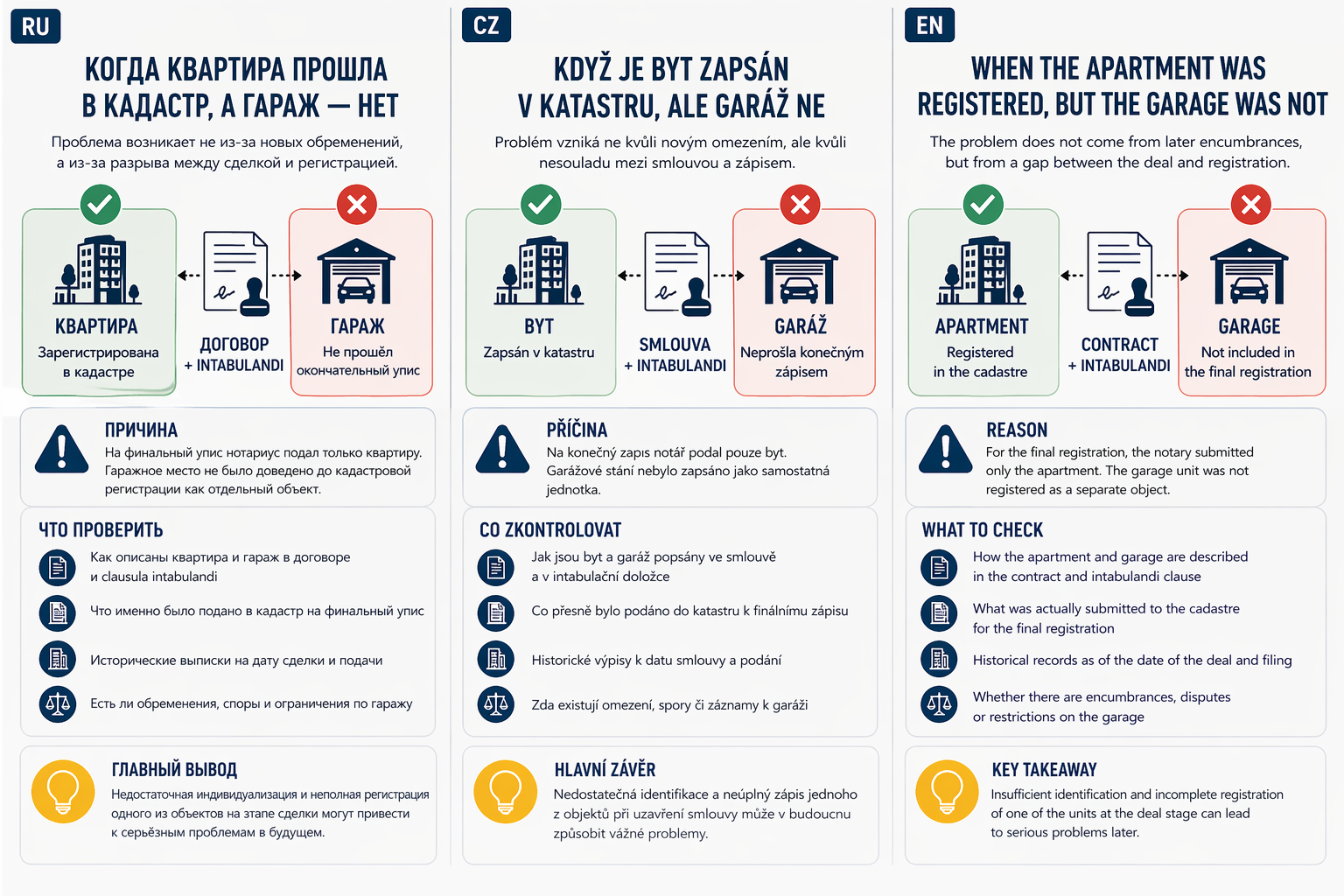
In this case involving LN 219 KO Budva, the most interesting issue is not the apartment, but the garage. Based on the documents, the apartment is identified as a separate unit, and appears to have gone through the transfer of title. The garage space, however, although commercially included in the deal, was most likely not brought to final cadastral registration as a separate unit.
That is where the core legal issue lies. In the sale agreement, the apartment was described with precise cadastral identification, while the garage was described much more weakly, simply as garage space number X. In other words, the parties were in fact dealing with an apartment and a garage together, but these two parts of the transaction were not formalized with the same legal and registration quality.
The key moment was the notary’s letter to the cadastre dated 25.01.2023. It shows that the final registration request concerned PD X only — the apartment. The garage was no longer mentioned in that letter. This means that at the stage of final cadastral implementation, the transaction moved forward not as “apartment + garage”, but as “apartment only”.
For that reason, the garage problem most likely did not arise because disputes, complaints or other restrictions appeared later. Those factors may have made the situation worse, but they were probably not the root cause. The deeper problem seems to be that the garage was never brought to a completed registration result in time and remained on its own separate title path.
What makes the case even more important is that the available materials strongly suggest that the garage corresponds to PDX— a parking unit which, in the current framework, is linked to Lux House doo. This is also supported by the building maintenance invoice. So this is not a minor detail or an informal add-on to the apartment, but a separate unit with its own legal fate.
The practical lesson is straightforward: when buying real estate in Montenegro, it is not enough to see the phrase “apartment with garage” in the contract. It is necessary to verify how each unit is individually identified, what exactly is covered by the clausula intabulandi, and what was actually submitted to the cadastre for final registration. Sometimes the problem does not arise later — it starts at the very beginning, when one unit is properly carried through and the other is not.
That is where the core legal issue lies. In the sale agreement, the apartment was described with precise cadastral identification, while the garage was described much more weakly, simply as garage space number X. In other words, the parties were in fact dealing with an apartment and a garage together, but these two parts of the transaction were not formalized with the same legal and registration quality.
The key moment was the notary’s letter to the cadastre dated 25.01.2023. It shows that the final registration request concerned PD X only — the apartment. The garage was no longer mentioned in that letter. This means that at the stage of final cadastral implementation, the transaction moved forward not as “apartment + garage”, but as “apartment only”.
For that reason, the garage problem most likely did not arise because disputes, complaints or other restrictions appeared later. Those factors may have made the situation worse, but they were probably not the root cause. The deeper problem seems to be that the garage was never brought to a completed registration result in time and remained on its own separate title path.
What makes the case even more important is that the available materials strongly suggest that the garage corresponds to PDX— a parking unit which, in the current framework, is linked to Lux House doo. This is also supported by the building maintenance invoice. So this is not a minor detail or an informal add-on to the apartment, but a separate unit with its own legal fate.
The practical lesson is straightforward: when buying real estate in Montenegro, it is not enough to see the phrase “apartment with garage” in the contract. It is necessary to verify how each unit is individually identified, what exactly is covered by the clausula intabulandi, and what was actually submitted to the cadastre for final registration. Sometimes the problem does not arise later — it starts at the very beginning, when one unit is properly carried through and the other is not.