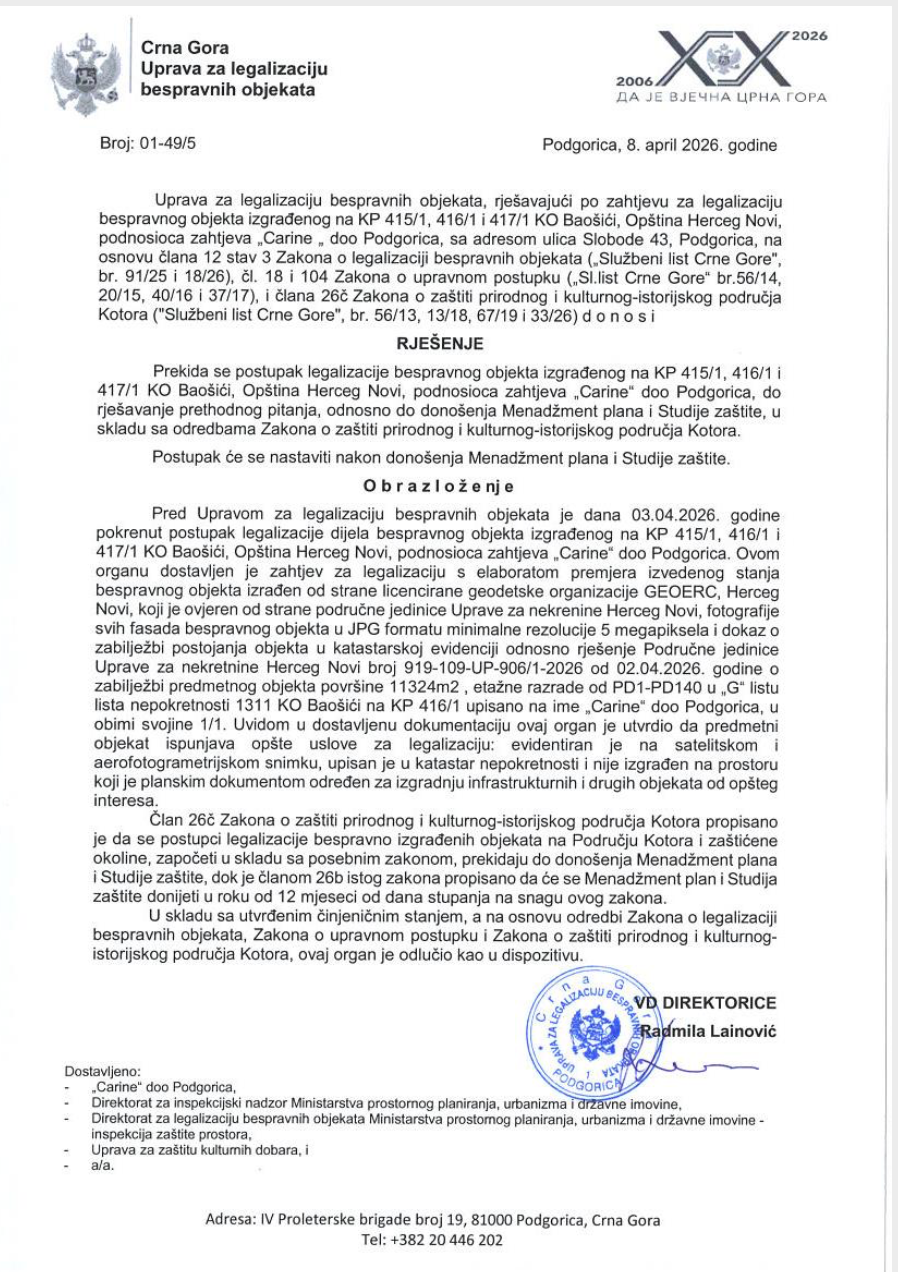
On 08 April 2026, a decision was issued that highlights an important practical risk in building legalization cases in Montenegro. The authority did not reject the legalization request; instead, it suspended the procedure on the basis of Article 26c of the Law on the Protection of the Natural and Cultural-Historical Area of Kotor (“Official Gazette of Montenegro”, Nos. 56/13, 13/18, 67/19 and 33/26) — until the adoption of the Management Plan and the Protection Study. The text of the decision also refers to Article 26b of the same law.
What is particularly important, however, is something else. In the decision itself, the authority specifically records that the building:
— is visible on the images;
— is entered in the cadastre;
— is not located on land designated for infrastructure or another facility of public interest.
In other words, this is a case where the matter was stopped not because the building was automatically deemed ineligible for legalization, and not because the authority had already established the classic set of obstacles relating to the building itself. The procedure was put on hold because of the special legal regime of the territory and the direct effect of a legal provision requiring the authority to wait for additional documents to be adopted.
This is a very important practical conclusion for property owners.
Many people still assess the prospects for legalization too simplistically: whether the building appears on orthoimagery, whether it is registered in the cadastre, whether the areas match, and whether the basic documents have been collected. But that type of review does not capture the full legal picture.
This case shows that even where some of the basic conditions are met, the procedure may still be stopped for an external reason. And that reason lies not in the applicant’s documents, but in the law governing the specific territory.
In such cases, the main risk is the following:
legally, this is not yet a refusal,
but in practice the case may remain frozen for a long time, because its progress depends on the adoption of the Management Plan and the Protection Study.
That is why a proper preliminary review of a property should include not only an analysis of the cadastre and the owner’s documents, but also a review of:
— the legal regime of the territory;
— special laws applicable in the specific zone;
— external restrictions capable of stopping the procedure;
— the case’s dependence on future state acts and plans.
Otherwise, the owner may face the most unpleasant situation: the building formally meets part of the basic criteria, but the procedure still does not move forward.
The practical conclusion is simple:
before filing for legalization, it is necessary to review not only the building itself, but also the entire legal environment surrounding it.
What is particularly important, however, is something else. In the decision itself, the authority specifically records that the building:
— is visible on the images;
— is entered in the cadastre;
— is not located on land designated for infrastructure or another facility of public interest.
In other words, this is a case where the matter was stopped not because the building was automatically deemed ineligible for legalization, and not because the authority had already established the classic set of obstacles relating to the building itself. The procedure was put on hold because of the special legal regime of the territory and the direct effect of a legal provision requiring the authority to wait for additional documents to be adopted.
This is a very important practical conclusion for property owners.
Many people still assess the prospects for legalization too simplistically: whether the building appears on orthoimagery, whether it is registered in the cadastre, whether the areas match, and whether the basic documents have been collected. But that type of review does not capture the full legal picture.
This case shows that even where some of the basic conditions are met, the procedure may still be stopped for an external reason. And that reason lies not in the applicant’s documents, but in the law governing the specific territory.
In such cases, the main risk is the following:
legally, this is not yet a refusal,
but in practice the case may remain frozen for a long time, because its progress depends on the adoption of the Management Plan and the Protection Study.
That is why a proper preliminary review of a property should include not only an analysis of the cadastre and the owner’s documents, but also a review of:
— the legal regime of the territory;
— special laws applicable in the specific zone;
— external restrictions capable of stopping the procedure;
— the case’s dependence on future state acts and plans.
Otherwise, the owner may face the most unpleasant situation: the building formally meets part of the basic criteria, but the procedure still does not move forward.
The practical conclusion is simple:
before filing for legalization, it is necessary to review not only the building itself, but also the entire legal environment surrounding it.