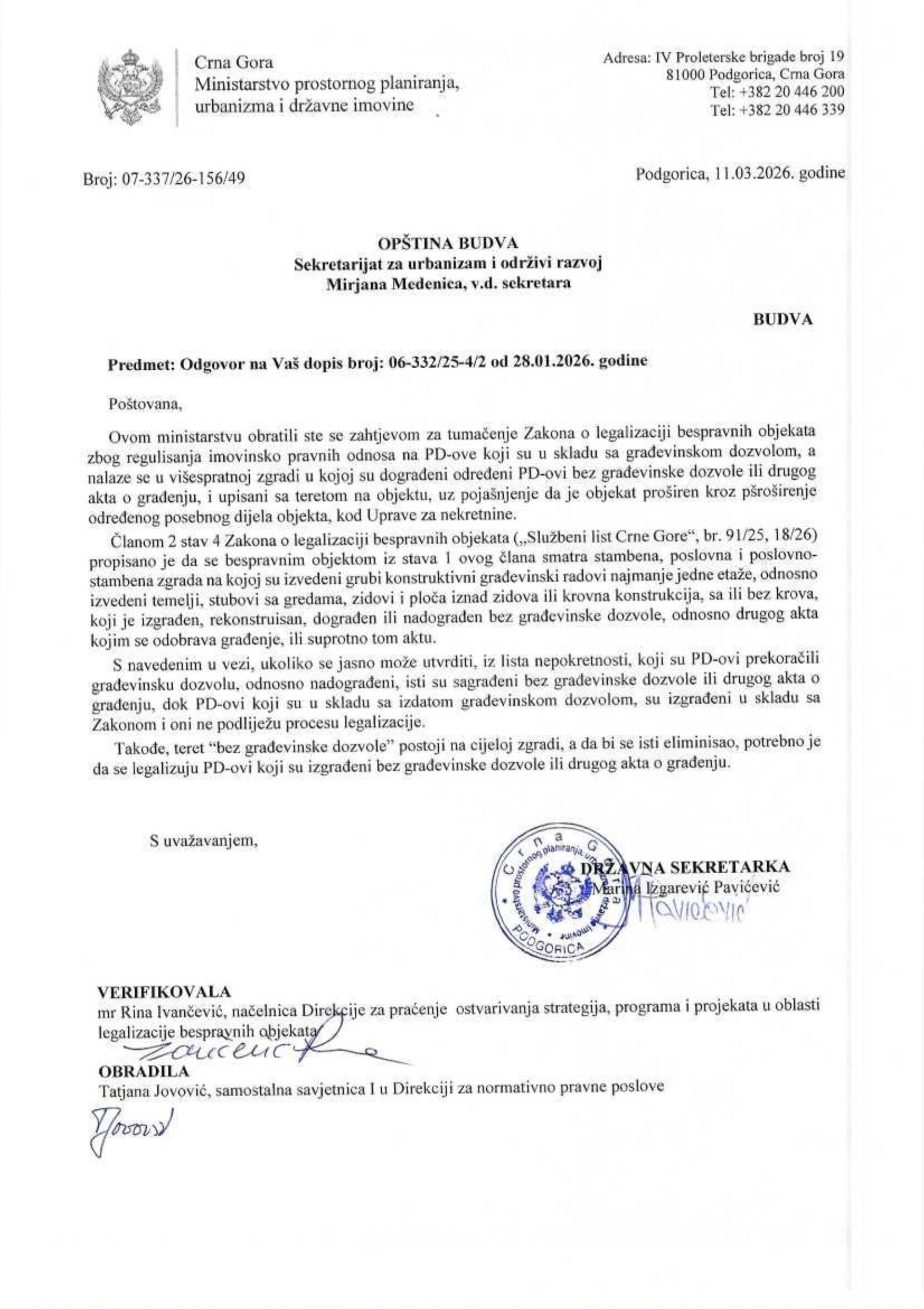
On 11 March 2026, the Ministry of Spatial Planning, Urbanism and State Property of Montenegro sent an official clarification to Opština Budva regarding the application of the Law on the Legalization of Illegal Structures in one of the most important practical scenarios.
This concerns a situation where, within the same multi-storey or multi-unit building, some special parts (PDs) comply with the issued građevinska dozvola (building permit), while others were extended, added to, or enlarged without a permit or beyond the scope of the permit.
These are exactly the cases that create the most confusion among owners in practice. When there is a general encumbrance recorded against the building, many assume that legalization must automatically apply to the entire building. However, the Ministry’s letter confirms a more precise approach.
The Ministry’s position is essentially the following.
If it is possible to clearly determine from the title sheet (list nepokretnosti) which PDs were built, extended, or added to without a permit or contrary to the permit, those are the parts that should be treated as subject to legalization.
At the same time, those PDs that are in line with the issued građevinska dozvola are considered to have been built lawfully and do not, by themselves, fall within the legalization procedure merely because they are located in the same building as problematic parts.
This is an important practical conclusion. It confirms that in such cases one must distinguish between:
The letter also highlights a second important point. The general encumbrance “without a building permit” may remain on the entire building until the PDs that were actually built without a permit are properly regularized.
In other words, a specific PD may be “clean” in itself and may not require legalization, while the general burden on the building may still remain.
For owners, this means something simple but important: the general problematic status of the building should not automatically be transferred to every apartment or every special part. At the same time, it is not enough to rely on a single cadastral entry without a detailed legal and technical review.
In practice, such cases require analysis of:
Only by comparing these materials can one determine which PD truly needs to enter the legalization procedure and which does not.
For practice in Budva, this letter is especially important because it was addressed to the local authority that handles such procedures. It is not a statute and not a court ruling, but it is an official administrative interpretation issued by the competent ministry, and it can be used as a strong basis for legal argumentation.
The main practical takeaway is this:
in problematic buildings, legalization should not be assessed only at the level of the building as a whole, but also at the level of each individual PD.
This is the approach that allows practitioners to separate genuinely unlawful parts from those that comply with the permit and to structure the next procedural steps correctly.
This concerns a situation where, within the same multi-storey or multi-unit building, some special parts (PDs) comply with the issued građevinska dozvola (building permit), while others were extended, added to, or enlarged without a permit or beyond the scope of the permit.
These are exactly the cases that create the most confusion among owners in practice. When there is a general encumbrance recorded against the building, many assume that legalization must automatically apply to the entire building. However, the Ministry’s letter confirms a more precise approach.
The Ministry’s position is essentially the following.
If it is possible to clearly determine from the title sheet (list nepokretnosti) which PDs were built, extended, or added to without a permit or contrary to the permit, those are the parts that should be treated as subject to legalization.
At the same time, those PDs that are in line with the issued građevinska dozvola are considered to have been built lawfully and do not, by themselves, fall within the legalization procedure merely because they are located in the same building as problematic parts.
This is an important practical conclusion. It confirms that in such cases one must distinguish between:
- the legal status of a specific PD;
- and the overall cadastral status of the building.
The letter also highlights a second important point. The general encumbrance “without a building permit” may remain on the entire building until the PDs that were actually built without a permit are properly regularized.
In other words, a specific PD may be “clean” in itself and may not require legalization, while the general burden on the building may still remain.
For owners, this means something simple but important: the general problematic status of the building should not automatically be transferred to every apartment or every special part. At the same time, it is not enough to rely on a single cadastral entry without a detailed legal and technical review.
In practice, such cases require analysis of:
- the title sheet;
- the building’s permit history;
- project and archival documentation;
- the elaborat and etažna razrada;
- the actual on-site condition of the property.
Only by comparing these materials can one determine which PD truly needs to enter the legalization procedure and which does not.
For practice in Budva, this letter is especially important because it was addressed to the local authority that handles such procedures. It is not a statute and not a court ruling, but it is an official administrative interpretation issued by the competent ministry, and it can be used as a strong basis for legal argumentation.
The main practical takeaway is this:
in problematic buildings, legalization should not be assessed only at the level of the building as a whole, but also at the level of each individual PD.
This is the approach that allows practitioners to separate genuinely unlawful parts from those that comply with the permit and to structure the next procedural steps correctly.