Why we publish this document
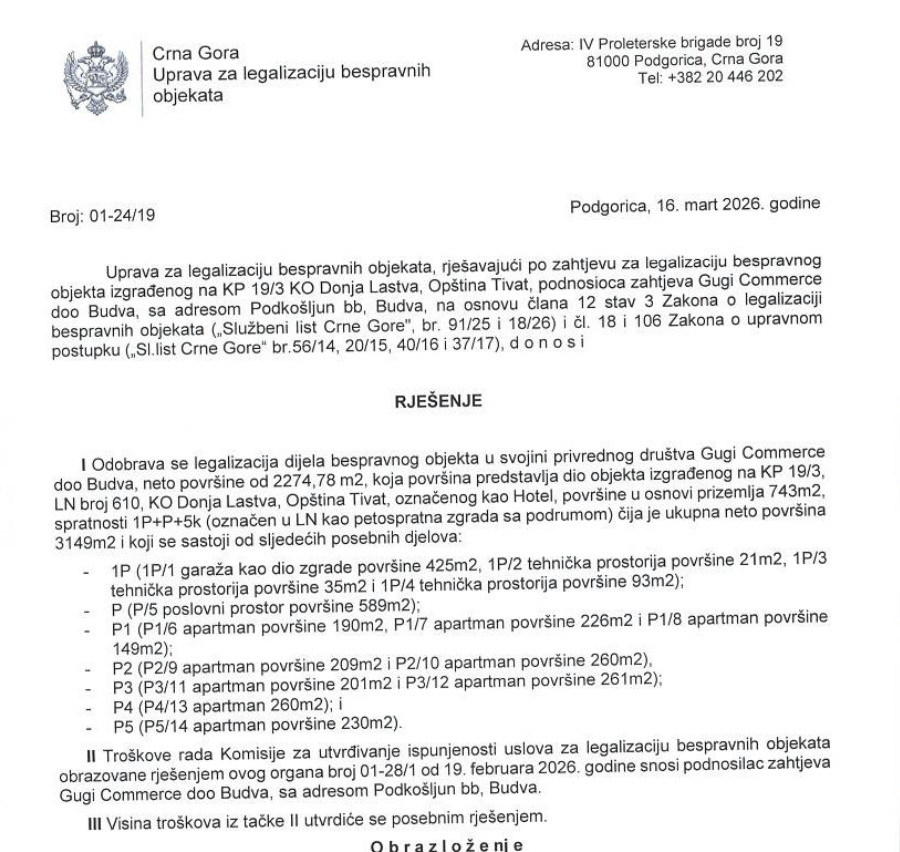
We use this file as a sample of an official legalization decision (RJEŠENJE). It is useful because it shows what the authority’s “final document” looks like, which details are mandatory, what wording is typically used, and which supporting documents/evidence commonly form the basis for an approved decision.
What this document is
Important: In Montenegro, a legalization decision may refer to the entire property or only a part of it — this document clearly demonstrates how that is formulated.
How a legalization decision is structured
In practice, such decisions are usually read “top to bottom” in the following order:
What matters for owners and practitioners
This sample works as a “checklist” because it shows:
We use this file as a sample of an official legalization decision (RJEŠENJE). It is useful because it shows what the authority’s “final document” looks like, which details are mandatory, what wording is typically used, and which supporting documents/evidence commonly form the basis for an approved decision.
What this document is
- Authority: Montenegro – Administration for Legalization of Illegal Structures (Uprava za legalizaciju bespravnih objekata).
- Reference number: 01-24/19.
- Date: 16 March 2026, Podgorica.
- Property location: Municipality of Tivat, KO Donja Lastva, KP 19/3 (the text also mentions LN No. 610).
- Essence of the decision: legalization of part of an illegal structure is approved (the property is qualified as a hotel; special units/premises are listed).
Important: In Montenegro, a legalization decision may refer to the entire property or only a part of it — this document clearly demonstrates how that is formulated.
How a legalization decision is structured
In practice, such decisions are usually read “top to bottom” in the following order:
- Header and formal details
- Authority name, address/contacts, case/reference number, date and place of issuance.
- Introductory section
- States which application (zahtjev) and which property the procedure concerns: KP/KO/Municipality, applicant details, and the legal grounds (references to the legalization law and administrative procedure rules).
- Operative part (RJEŠENJE)
- The key block: “odobrava se legalizacija…” — legalization is approved, and it specifies:
- what exactly is being legalized (the property / part of the property),
- core parameters (area, floors/levels, list of special units).
- Reasoning (Obrazloženje)
- One of the most practical sections: the authority explains why it concluded legalization is possible and what it relied on. Typically, it includes:
- relevant legal conditions/criteria (e.g., visibility in imagery / cadastral records, planning issues, ownership/rights regularization, etc.),
- a record of which documents were submitted,
- possible references to inspections/site visits/authority checks.
- Attachments and evidence (what the authority considered)
- This document lists typical items that often matter in practice:
- LN (list nepokretnosti) for the property,
- structural/seismic stability materials (report + review),
- project-related documentation (main design / glavni projekat) and reviews,
- other documents confirming the condition and acceptability of further use/operation.
- Legal remedies (Uputstvo o pravnoj zaštiti)
- A standard section explaining where and within what deadline an appeal/lawsuit can be filed (often the Administrative Court, deadlines such as 20 days; exact wording depends on the authority and the act type).
What matters for owners and practitioners
This sample works as a “checklist” because it shows:
- Which identifiers are critical: KO / KP / LN (and sometimes PD when special units are involved).
- What authorities typically want to see as evidence: not only geodetics and “as-built” documentation, but also (depending on the property) structural/seismic reports and formal reviews.
- That a decision may legalize only a “part” of a property — and then the operative section often contains a detailed list of special units (posebni djelovi).