Montenegro Legalization Deadline Officially Extended to 14 August 2027
We can now discuss the amendments on the basis of the final officially published text.
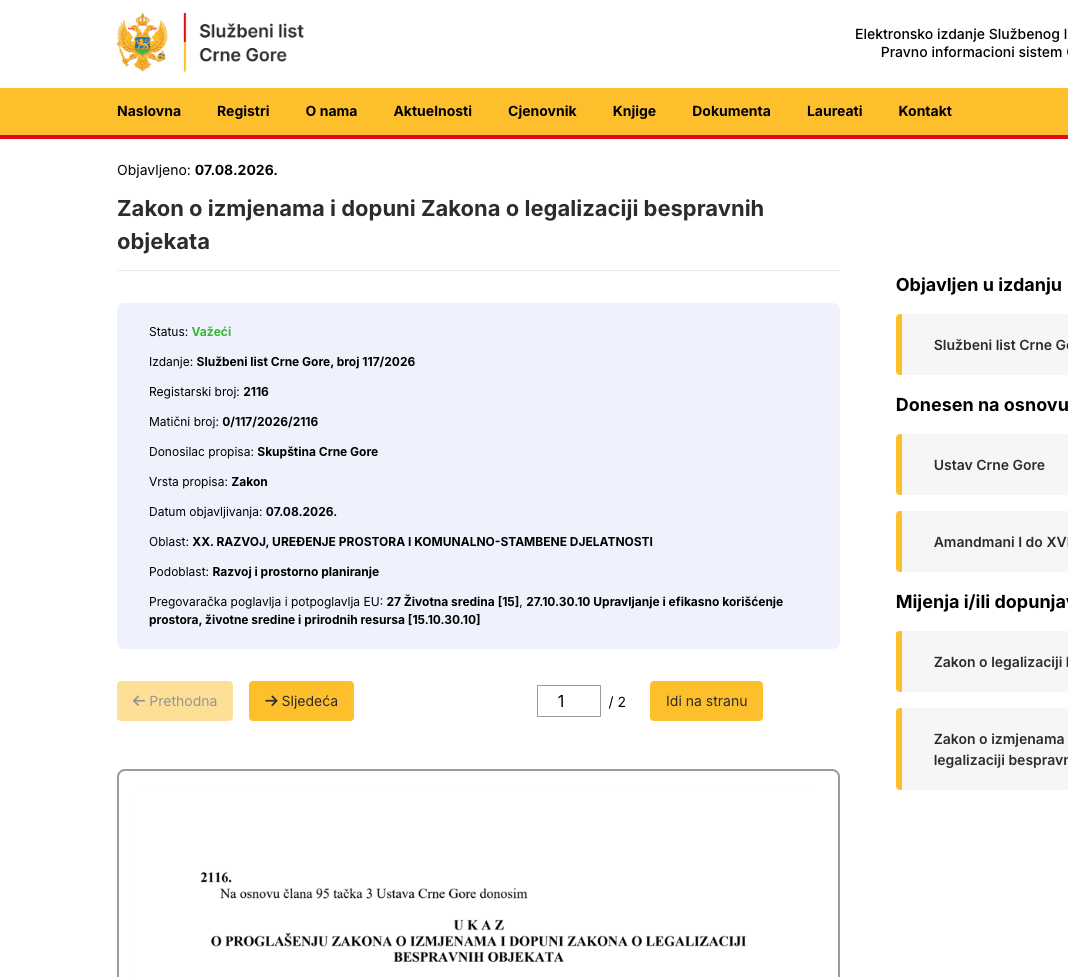
On 7 August 2026, the Law on Amendments and Supplement to the Law on Legalization of Unauthorized Buildings was published in the Official Gazette of Montenegro, No. 117/2026.
The Parliament of Montenegro adopted the Law on 31 July 2026. The President of Montenegro issued the Decree promulgating it on 3 August, and the Law was officially published on 7 August.
The most important change is the extension of the period provided for under Article 48 from 12 to 24 months.
However, this is not the only amendment.
The deadline has been extended from 12 to 24 months
Article 2 of the new Law replaces the words “within 12 months” in Article 48(1) with “within 24 months”.
For owners of unauthorized buildings that have not yet been entered in the Real Estate Cadastre, this effectively extends the relevant statutory period for initiating the registration procedure until 14 August 2027.
Legal precision is important here.
Rather than simply saying that “legalization has been extended for another year”, the amendment specifically extends the statutory period established under Article 48 from 12 to 24 months.
The composition of the commission is changing
Another practically significant amendment concerns the composition of the commission.
Previously, Article 14 required one of its members to be a representative of the Cadastre with a geodetic professional background.
The amended provision instead requires one member of the commission to be an authorized engineer in the field of geodesy.
Therefore, the geodetic specialist no longer has to be a representative of the Cadastre.
In practice, this may make it easier to form commissions and reduce delays caused by the limited availability of geodetic professionals employed directly by the Cadastre.
Commission members are entitled to remuneration
The amended Law also provides that members of the commission, as well as its secretary where one has been appointed by the act establishing the commission, are entitled to remuneration for their work.
Property owners will pay the costs of the on-site inspection
Another important change directly affects property owners.
The Law expressly provides that the costs of visiting the site and inspecting the unauthorized building are to be borne by the owner of that building.
This introduces an additional official cost into the legalization procedure.
How much will the inspection cost?
The Law itself does not establish specific amounts.
These will be determined separately by the competent Ministry.
Among other matters, the Ministry is required to regulate:
— the contents of the inspection record;
— the scope and types of work performed by the commission;
— the amount of the costs of inspecting an unauthorized building on site;
— remuneration for commission members;
— remuneration for the commission secretary;
— other matters relating to the work of the commission.
The relevant implementing regulation issued by the Ministry will therefore be the next important document for the practical application of these amendments.
KF Legalafy will monitor its adoption and publication separately.
The amendments do not introduce a new “complete package” requirement
This point deserves particular attention.
Before publication of the final text, various reports and assumptions circulated regarding a possible tightening of documentation requirements and a requirement to submit a complete set of documents at the very beginning of the procedure.
No such new requirement appears in the published Law on Amendments and Supplement.
These amendments do not establish a new list of documents for the initial filing, nor do they introduce a rule under which the procedure may only be initiated with a “complete package” of documentation.
If additional requirements are subsequently introduced through implementing regulations or official instructions issued by the competent authorities, we will analyse them separately.
When do the amendments enter into force?
Article 3 provides that the Law enters into force on the eighth day following its publication in the Official Gazette of Montenegro.
It was published on 7 August 2026.
Accordingly, the new provisions enter into force on 15 August 2026.
What does this mean for property owners?
The additional year is certainly welcome news.
However, we would not recommend treating the extension as a reason to postpone legalization for another year.
In our practice, we regularly encounter situations where an owner believes that filing an application means everything has been completed and all that remains is to wait. A review of the case may reveal errors, missing documents, discrepancies between cadastral records and the actual condition of the property, land-related issues or other circumstances that require additional time to resolve.
The additional period should therefore be used to review the status of an existing case and resolve potential problems before they affect the final outcome.
KF Legalafy reviews already initiated legalization cases, analyses documentation and provides support throughout the legalization procedure until the result is obtained.
We will also continue monitoring new implementing regulations issued by the Ministry and official guidance from the authorities responsible for applying the Law.
KF Legalafy — official sources first, professional conclusions second.
Our Contacts
Website: https://kf-legalafy.me
E-mail: office@kf-legalafy.me
WhatsApp Business: +382 68 113 955
Telegram: @Legalafy
Viber: +382 68 103 993
We can now discuss the amendments on the basis of the final officially published text.
On 7 August 2026, the Law on Amendments and Supplement to the Law on Legalization of Unauthorized Buildings was published in the Official Gazette of Montenegro, No. 117/2026.
The Parliament of Montenegro adopted the Law on 31 July 2026. The President of Montenegro issued the Decree promulgating it on 3 August, and the Law was officially published on 7 August.
The most important change is the extension of the period provided for under Article 48 from 12 to 24 months.
However, this is not the only amendment.
The deadline has been extended from 12 to 24 months
Article 2 of the new Law replaces the words “within 12 months” in Article 48(1) with “within 24 months”.
For owners of unauthorized buildings that have not yet been entered in the Real Estate Cadastre, this effectively extends the relevant statutory period for initiating the registration procedure until 14 August 2027.
Legal precision is important here.
Rather than simply saying that “legalization has been extended for another year”, the amendment specifically extends the statutory period established under Article 48 from 12 to 24 months.
The composition of the commission is changing
Another practically significant amendment concerns the composition of the commission.
Previously, Article 14 required one of its members to be a representative of the Cadastre with a geodetic professional background.
The amended provision instead requires one member of the commission to be an authorized engineer in the field of geodesy.
Therefore, the geodetic specialist no longer has to be a representative of the Cadastre.
In practice, this may make it easier to form commissions and reduce delays caused by the limited availability of geodetic professionals employed directly by the Cadastre.
Commission members are entitled to remuneration
The amended Law also provides that members of the commission, as well as its secretary where one has been appointed by the act establishing the commission, are entitled to remuneration for their work.
Property owners will pay the costs of the on-site inspection
Another important change directly affects property owners.
The Law expressly provides that the costs of visiting the site and inspecting the unauthorized building are to be borne by the owner of that building.
This introduces an additional official cost into the legalization procedure.
How much will the inspection cost?
The Law itself does not establish specific amounts.
These will be determined separately by the competent Ministry.
Among other matters, the Ministry is required to regulate:
— the contents of the inspection record;
— the scope and types of work performed by the commission;
— the amount of the costs of inspecting an unauthorized building on site;
— remuneration for commission members;
— remuneration for the commission secretary;
— other matters relating to the work of the commission.
The relevant implementing regulation issued by the Ministry will therefore be the next important document for the practical application of these amendments.
KF Legalafy will monitor its adoption and publication separately.
The amendments do not introduce a new “complete package” requirement
This point deserves particular attention.
Before publication of the final text, various reports and assumptions circulated regarding a possible tightening of documentation requirements and a requirement to submit a complete set of documents at the very beginning of the procedure.
No such new requirement appears in the published Law on Amendments and Supplement.
These amendments do not establish a new list of documents for the initial filing, nor do they introduce a rule under which the procedure may only be initiated with a “complete package” of documentation.
If additional requirements are subsequently introduced through implementing regulations or official instructions issued by the competent authorities, we will analyse them separately.
When do the amendments enter into force?
Article 3 provides that the Law enters into force on the eighth day following its publication in the Official Gazette of Montenegro.
It was published on 7 August 2026.
Accordingly, the new provisions enter into force on 15 August 2026.
What does this mean for property owners?
The additional year is certainly welcome news.
However, we would not recommend treating the extension as a reason to postpone legalization for another year.
In our practice, we regularly encounter situations where an owner believes that filing an application means everything has been completed and all that remains is to wait. A review of the case may reveal errors, missing documents, discrepancies between cadastral records and the actual condition of the property, land-related issues or other circumstances that require additional time to resolve.
The additional period should therefore be used to review the status of an existing case and resolve potential problems before they affect the final outcome.
KF Legalafy reviews already initiated legalization cases, analyses documentation and provides support throughout the legalization procedure until the result is obtained.
We will also continue monitoring new implementing regulations issued by the Ministry and official guidance from the authorities responsible for applying the Law.
KF Legalafy — official sources first, professional conclusions second.
Our Contacts
Website: https://kf-legalafy.me
E-mail: office@kf-legalafy.me
WhatsApp Business: +382 68 113 955
Telegram: @Legalafy
Viber: +382 68 103 993